
Organised by BIMA’s Diversity Council.
Presented by Roxanne Hobbs, Founder, The Hobbs Consultancy and Nadya Powell, Co Founder, Utopia and Kathryn Dooks, Employment Partner at Kemp Little.
BIMA has joined forces with Kemp Little LLP to look at the legal realities of harassment. What, legally speaking, is it? What are your rights? What should you do if you feel you are being harassed right now?
Every day, another story. What began with Weinstein and Spacey has sprawled to include a growing number of Hollywood power-mongers and a seemingly never-ending list of famous names. Yet as those stars have been keen to point out, harassment isn’t only the preserve of Hollywood. It’s happening in your industry too. And when you don’t have a team of leading actors in your corner or a hashtag to call you own, harassment can feel an even more horrible and lonely thing to face.
So, with thanks to Kathryn Dooks, Employment Partner at Kemp Little, whose BIMA presentation provides the legal backdrop to this post, here’s your bitesize guide to harassment in the workplace.
Harassment is unwanted conduct which has the purpose or effect of either:
• Violating your dignity; or
• Creating an intimidating, hostile, degrading, humiliating or offensive environment
Behaviour doesn’t have to be ongoing or long-standing to be considered harassment – it could be a one-off incident.
It could still be harassment, even if:
• You haven’t made the perpetrator aware that the conduct is unwanted (you don’t have to tell them)
• You have put up with the conduct for years or even joined in with the ‘banter’
• Comments aren’t directed at you, as long as you are offended by the behaviour
The legal position here (and therefore the position a manager should take if you raise it with them) is to assess the situation from your viewpoint, with a presumption that the conduct was unwarranted unless it can be proved otherwise.
Any investigation should start with your perception, then look at the other circumstances in the case, then ask whether it is reasonable for the conduct to have that effect. It does not matter that the person whose conduct is in question didn’t intend their words/actions to offend, humiliate etc.
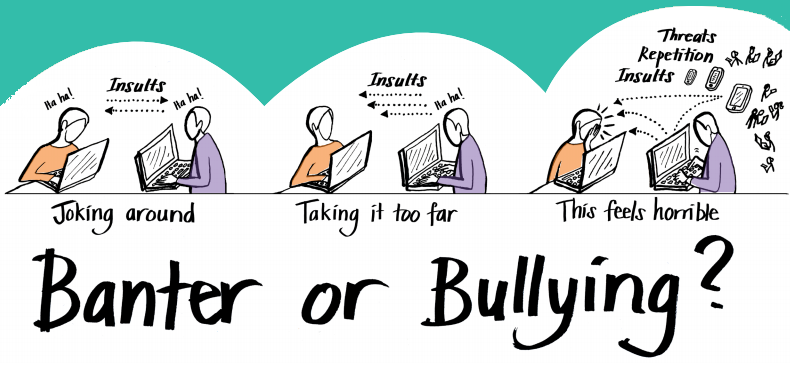
Banter is joking around where everyone’s in on the joke, and everyone sees the funny side of the insults that are hurled from both sides. But when it stops being funny. When the insults come from one direction. Or when the banter is shared between multiple parties and you end up on the receiving end of repeated insults or threats from several sources, it’s no longer banter.
Not all harassment comes from within the workplace. Employers can still be liable if their reaction to a client’s harassment of you is poor or unsupportive.
If you can, it’s always better to try to resolve issues informally with the perpetrator first. If you feel unable to do that, perhaps ask a colleague to raise the matter for you.
You might also consider:
• Talking to colleagues to find out if anyone else is suffering / has witnessed what has happened to you
• Going to see someone who you feel comfortable discussing the problem with on an informal basis (perhaps your line manager or HR)
• Keeping a diary of incidents – dates, times, witnesses, your feelings
If the above informal approach doesn’t resolve the issue, consider raising a formal grievance. Before you do, think about the following:
• How would you like the matter to be resolved (e.g. informally, mediation, disciplinary action etc)?
• If your grievance were not upheld, would you feel able to stay in the business?
When planning your grievance application, remember to:
1. Follow company procedure (there should be clear guidance available within your company on how to raise a grievance)
2. Set out the incidents in chronological order, including dates, full details and any witnesses
By raising a grievance you’ll trigger an investigation into the matter and there should be a grievance hearing where the outcome of your compliant can be decided. This hearing should be in private and you’ll have the right to be accompanied. If you feel your grievance isn’t handled correctly, you should have a right of appeal.
The usual deadline for bringing a claim against your employer for harassment is three months from the date of the act complained of. However, this can be extended in some circumstances (you should take legal advice about this).
You no longer have to pay a fee to bring an Employment Tribunal claim. If you bring a harassment claim, whilst you remain in work and there’s no minimum length of service requirement. However, the tribunal will expect you to have tried to resolve the issue with the company first and continuing to work whilst a tribunal is pending can be stressful.
Alternatively, and if the behaviour / reaction to your complaint is sufficiently serious, you may be able to resign and claim constructive unfair dismissal. You’ll usually need to have two years’ service in order to do this and you’ll be left without pay pending the hearing, so you should take legal advice before taking this step.
If you’d like to find out more about your rights, or you want practical help in dealing with harassment, take a look at the following:
NABS 0800 707 6607
ACAS 0300 123 1100
Various women’s networks
Equality Advisory Service 0808 800 0082
Find a solicitor here.