
By Emma Wharton Love, Co-Founder of Spark AI
Since launching Spark AI, I’ve made it my mission to track AI adoption across agencies every six months. We started doing so in 2024.
By the fourth edition of the Spark Report, our biggest to date, we have been able to uncover some truly revealing insights.
Agency teams are adopting AI confidently and independently – but leadership isn’t keeping pace.
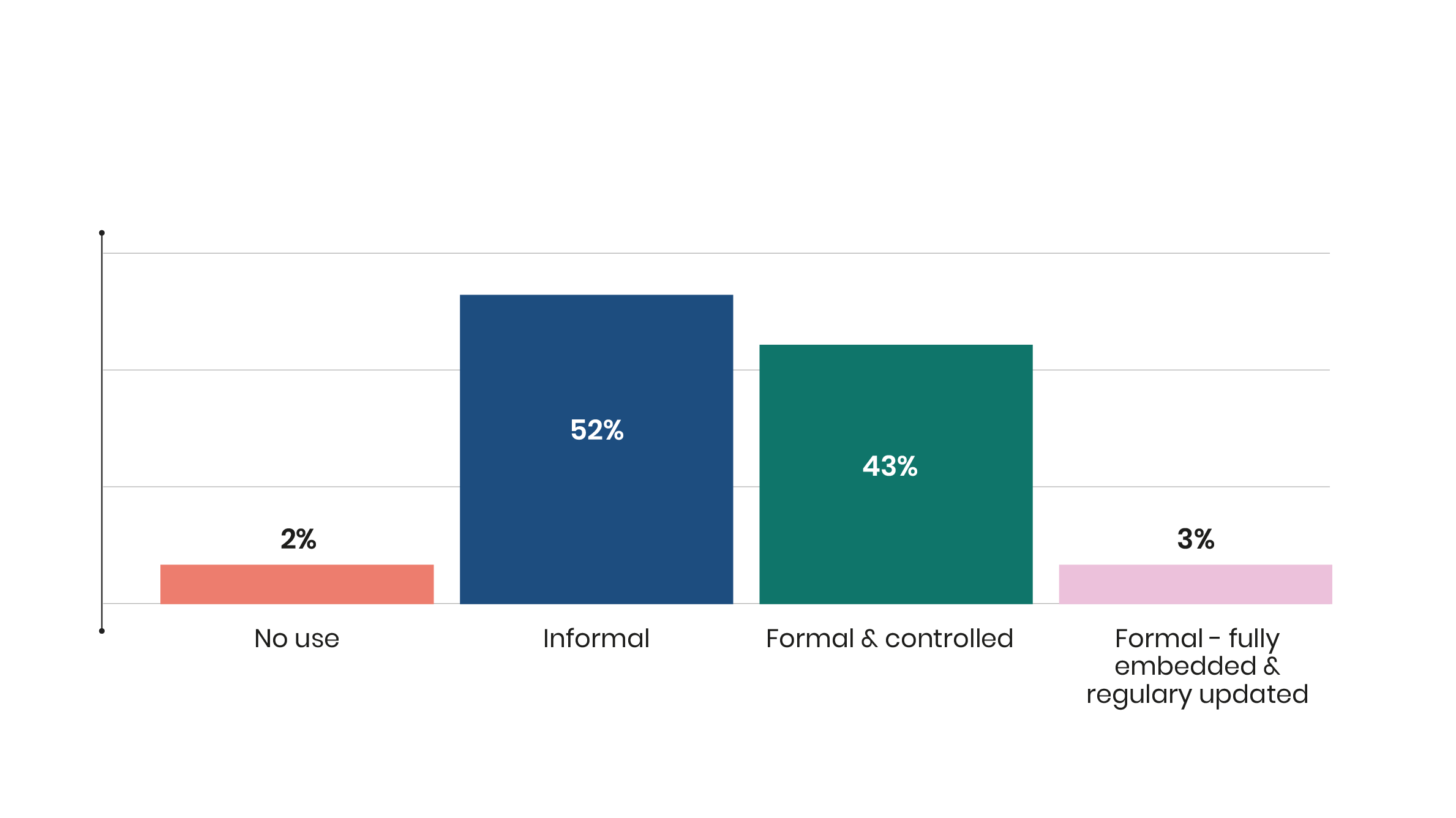
Our latest benchmark – drawing on quantitative data and qualitative insights from over 70 agencies – found that 84% are now using AI. That’s a remarkable number. Yet, 52% of that activity is entirely ungoverned. No policy, no process, and no shared framework for how AI should or shouldn’t be used.
To understand why, it helps to know how we frame progress.
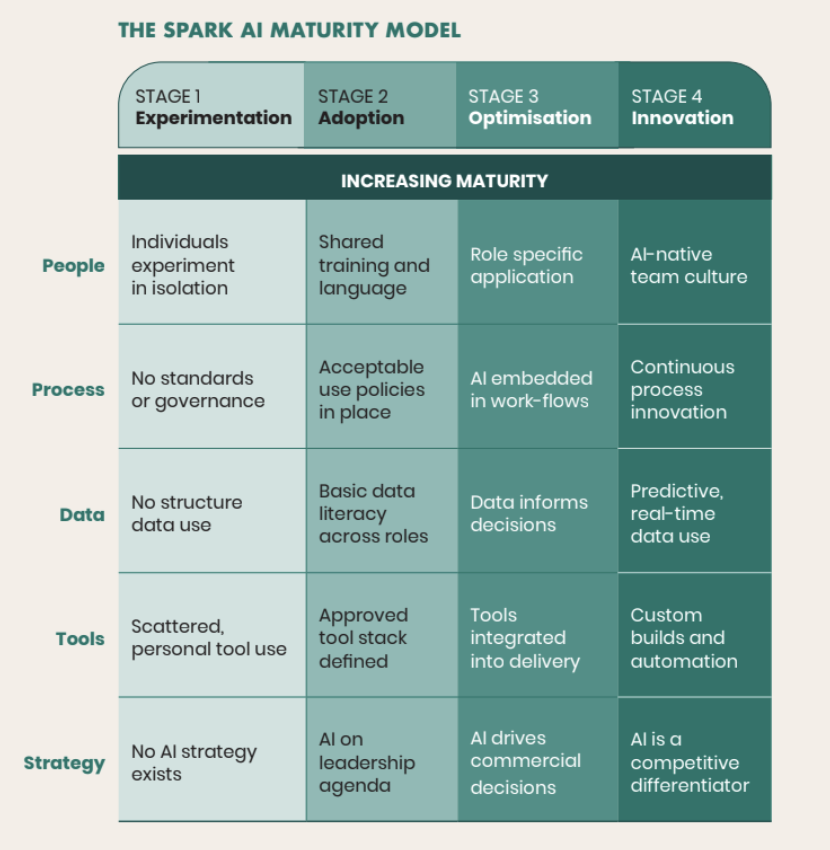
The Spark AI Maturity Model™ maps agencies across four stages:
Most agencies, right now, are sitting somewhere between Stage 1 and Stage 2. The gap between where their people are and where the organisation is sitting is the defining challenge of this edition.
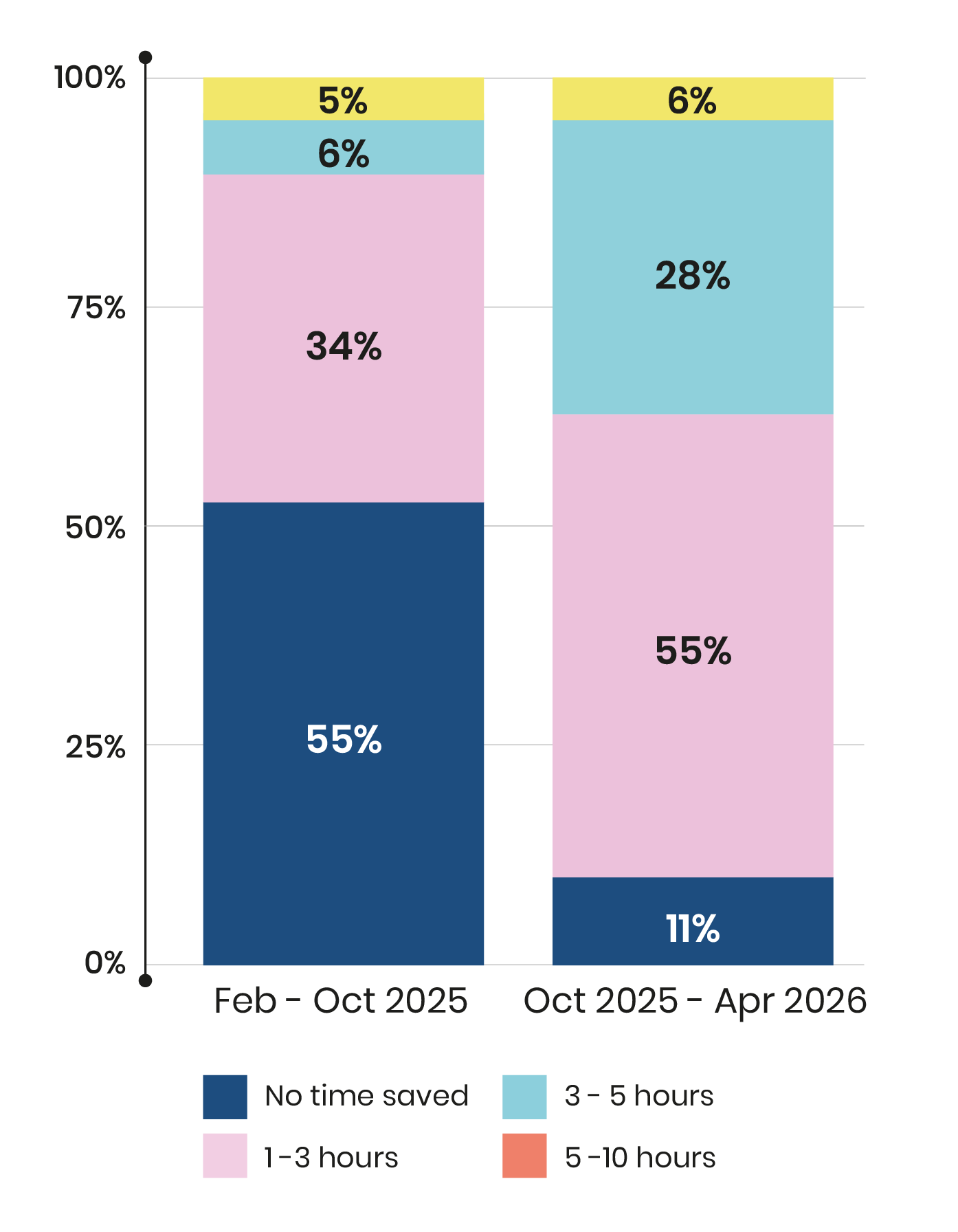
89% of staff are recovering up to ten hours a week through AI, which is exactly what AI tools promise. But almost all of that recovered time is being reabsorbed into emails and admin, the same tasks that AI was intended to alleviate.
Recovered AI hours are the biggest untapped asset in most agencies right now. The organisations pulling ahead are the ones asking a different question: not “how do we do more?” but “what do we actually do with the space AI creates?”
Our data shows a consistent pattern across agencies. Staff are using AI confidently and independently. But the commercial value of that activity – the recovered time, the creative capacity, the competitive edge – isn’t being captured at an organisational level.
As individual capability grows, so does awareness of what’s at stake. Interest in IP and data risk management has surged 50% in six months. The workforce already knows it needs guardrails. Leadership hasn’t provided them yet, but the window to do that proactively, before something goes wrong, is still open.
66% of staff describe themselves as capable AI users. Yet Only 15% are demonstrating the kind of AI fluency that actually unlocks business value – the structured, strategic, organisation-wide capability that moves AI from a personal productivity tool to a genuine competitive advantage.
In my experience, the most confident teams are sometimes the least aware of how far there still is to go. That’s not a criticism, but a pattern at every stage of technology adoption.decisions get made on the basis of confidence. Hiring, investment, client commitments. If confidence is running significantly ahead of actual fluency, those decisions deserve a closer look.
Another merging dynamic is that the gap between the most and least active AI users inside a single agency is now wider than the gap between agencies. A two-speed workforce is difficult to manage, impossible to standardise around, and a real risk to consistent client delivery. Your enthusiasts push ahead without the structures to support them and risk eventually burning out. Your sceptics take the absence of direction as confirmation that AI isn’t worth the effort. And the majority in the middle, who could go further, take their cue from the organisation and stay where they are.
Content generation has gone from 20% to 47% usage in six months. That has More than doubled in half a year. It’s the sharpest illustration of how quickly adoption moves and how quickly the ground shifts underneath agencies that aren’t paying attention.
Agencies that haven’t rethought their commercial models alongside their AI adoption risk being undercut by those that have. The tools have changed. The pricing, the scoping, the value conversation with clients need to change with them.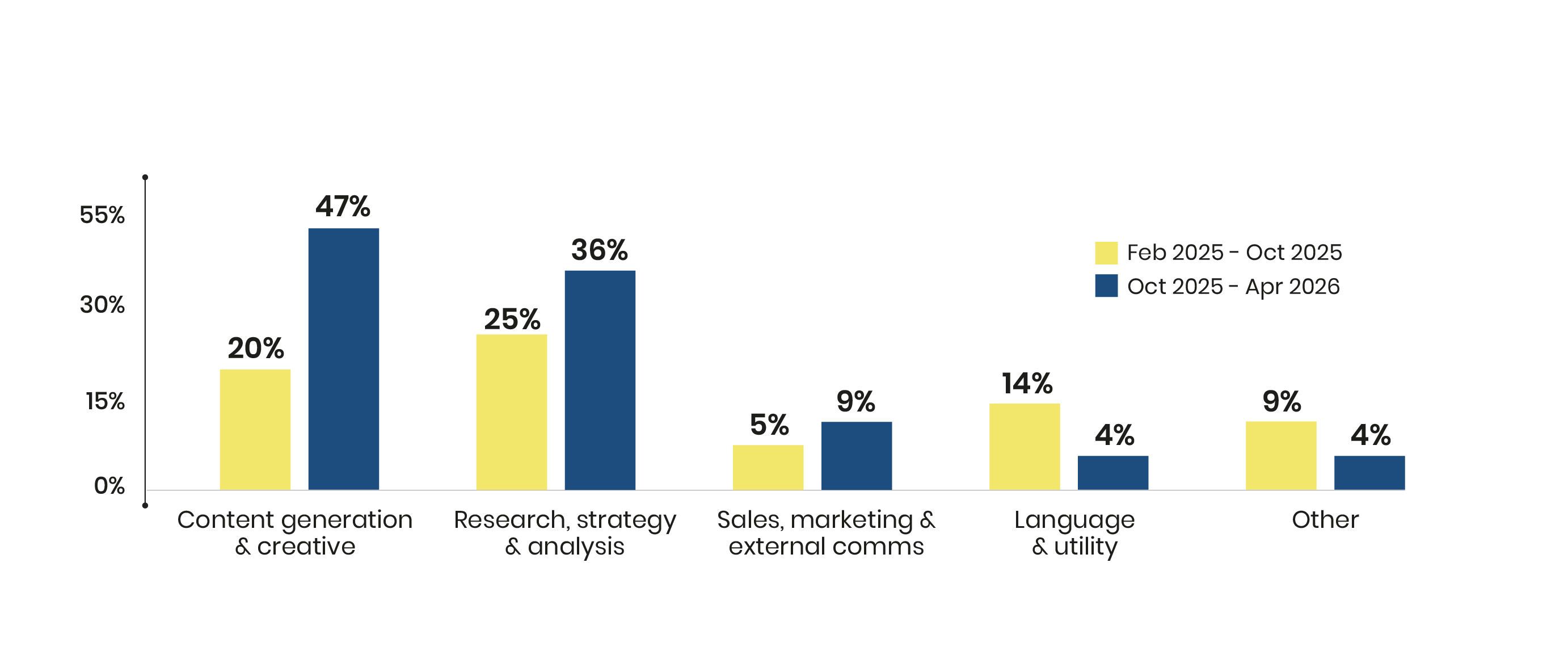
The good news (and there is genuine good news here) is that this is solvable. 90 days is enough time to move from fragmented experimentation to functioning capability. Once the skills, governance, and roadmap are in place, progress compounds.
Agency leaders have a real opportunity to define and strengthen their organisation’s AI strategy right now.
Read the full fourth edition of the Spark Report.
About Spark AI
Spark AI is a UK-based consultancy helping agencies and creative teams build organisation-wide AI capability. Founded by two of BIMA’s 100 most influential people in digital and tech, Spark works across people, process, and systems to ensure training and operational transformation stick long after the honeymoon period is over. Trusted by 70+ agencies and in-house brand teams from global networks to independents, we build the engine that changes what your organisation is capable of. Spark co-founder Jules Love is the author of the #1 Amazon bestseller Shift – AI in Agencies and teaches how to build an AI strategy at Oxford University’s AI for Business executive diploma.
For further information or to download the report, visit https://www.wearespark.ai