
Nearly everyone now uses AI at work, and few of us can say what it costs. Used carelessly, it can emit far more carbon than the people it replaces.
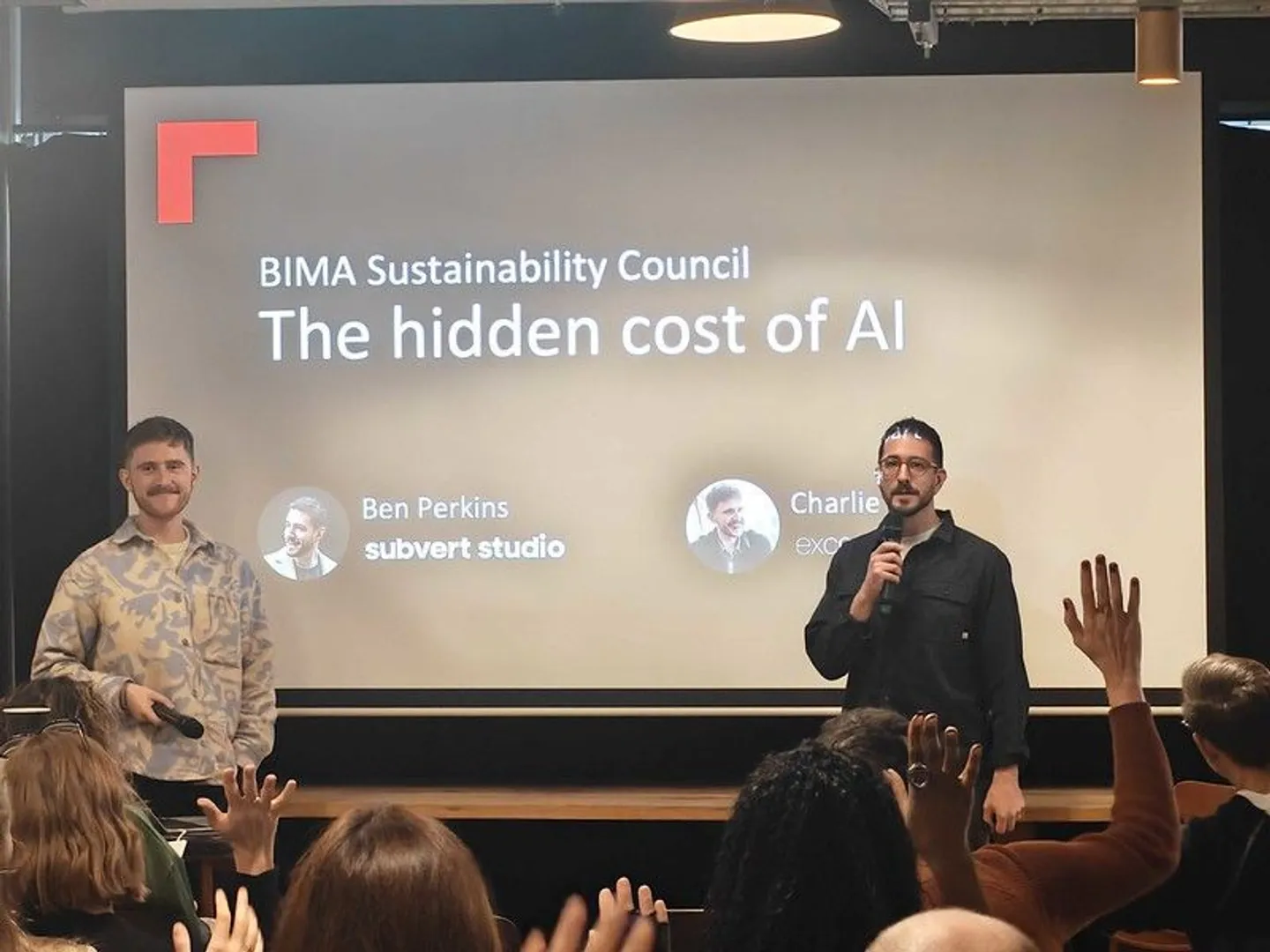
At the BIMA Assembly on 22 October, the Sustainability Council looked at where digital emissions come from, why we rarely discuss them now, and how AI is changing the picture.
Climate change is happening all around us. Recent projections point well past 1.5°C. Yet where several years ago there was a vocal movement to mobilise the marketing and digital industry behind the climate emergency, in recent years the subject has gone quiet. We've all felt it on the ground, and we've all seen it played out on the global stage.
We see two causes. First, the discourse has shifted to AI. Second, digital sustainability is becoming standard practice. We want it to follow the path accessibility took: a normal part of making good digital work. But when good practice goes behind closed doors, the public conversation fades, and it starts to look as if the problem has shrunk. It hasn’t.
Digital produces between 1.5% and 4% of global greenhouse gas emissions, about the same as the aviation or fashion industries. A campaign with a million ad impressions has roughly the footprint of one return flight from London to Boston. Digital is not a sector of its own, either. Its emissions sit across energy, industry, agriculture, transport and buildings, which means our work has wide ranging influence across the whole economy.
The ITU says emissions from digital need to fall 45% by 2030 to stay on a 1.5°C path. The IEA expects data centre electricity use to double between 2025 and 2030, and to triple for AI use. That's the wrong trajectory.
To understand the areas we can influence, we first need to understand where the emissions from digital products come from.
Any product, physical or digital, emissions can be categorised into four stages: what gets made, how it’s made, how it’s used and what happens at the end. Digital work follows the same shape:
What we make. The clients and briefs we take on are the easiest lever for most agencies. Challenge what the work is for, and build in measurement from day one to understand and learn from its impact.
How we make it. Heavy files, lazy code and weak targeting all mean more data stored and moved. Made-for-advertising sites took 15.3% of US open web ad spend and produce 26.4% more CO2 per thousand impressions. That wastes money and carbon at once.
How it gets used. 40% of digital emissions are driven by device-side activity, yet the role of the user is often underestimated in website carbon models. Clear and intuitive UX design means fewer wrong turns, fewer page loads and fewer returns.
What happens after. Check results against the goals you set, retire dead pages and unused data, and learn from what didn’t work.
Most of the room told us they use AI in their daily workflows. Every prompt runs in a data centre that needs power and water, and in many workflows AI may already be the largest single source of emissions. It doesn’t have to be, but its costs are easy to miss, and they sit in places we don’t look.
Task size. A typical ChatGPT query uses about 0.3 Wh. A long-input query, such as uploading a PDF and asking for analysis, uses about 2.9 Wh. A maximum-length query uses around 40 Wh. Energy use does not rise in a straight line: the more reasoning a model does, the faster the demand climbs. No one query will change the climate, but the habit adds up.
Oversized models. Most routine work, such as summaries and reformatting, does not need a frontier model. A smaller model can cut power and emissions by up to 97% for the same task. Providers want to sell more tokens, so the nudge will always be toward bigger. Match the model to the job.
False economy. A study in Nature ran the same coding tests through several models and compared them with human effort. A person averaged 0.33kg of CO2e per experiment. GPT-4 averaged 4.93kg. The smallest model, GPT-4o mini, came in at 0.16kg, about half the human figure. One model failed a test even after 100 attempts. Faster is not the same as cleaner.
The iteration penalty. Outputs are rarely right first time, especially on subjects you know well. Every retry costs energy, and a vague brief makes it worse. Being clear up front is a sustainability act.
The rebound effect. When things get easier, we do more of them. Ten times the ad variants, images or pages cancels any efficiency gain. Fashion saw the same with resale platforms, which can push people to buy more.
Clutter. Data that is stored and never used still has a footprint, and old pages and assets add to it. This now matters for AI search too: stale content can muddy what AI tools say about your brand.
“Use AI to make the work better or reduce waste. Not just to make more.”
AI can help as well as harm. Google used DeepMind to cut the energy used to cool its data centres by up to 40%. In our own work it can find wasted media spend, heavy files and unused code, and spot redundant tracking tools. The catch is to check that the savings outweigh the AI’s own energy use. This is not a case for using more AI in the hope it fixes itself.
Three habits to take back to your team:
Use the smallest model that does the job. Keep the heavy ones for real reasoning.
Choose quality over volume.
Point AI at waste reduction and save on cost as well as emissions.
Are you clear how AI is being used in your organisation?
Originally presented by Ben Perkins, Subvert Studio and Charlie Stewart, Exceptional, for the BIMA Sustainability Council. To help shape future council resources, get in touch.
Disclosure: this article was drafted with the help of Claude Sonnet 5.5. Over two iterations it used approx 11k input tokens at 0.04g CO2e per 1,000 tokens, and 2.8k output tokens at 0.9g CO2e per 1,000 tokens, generating approx. 3g CO2e. Comparative human impact 1.4g CO2e (4 hours laptop work).